
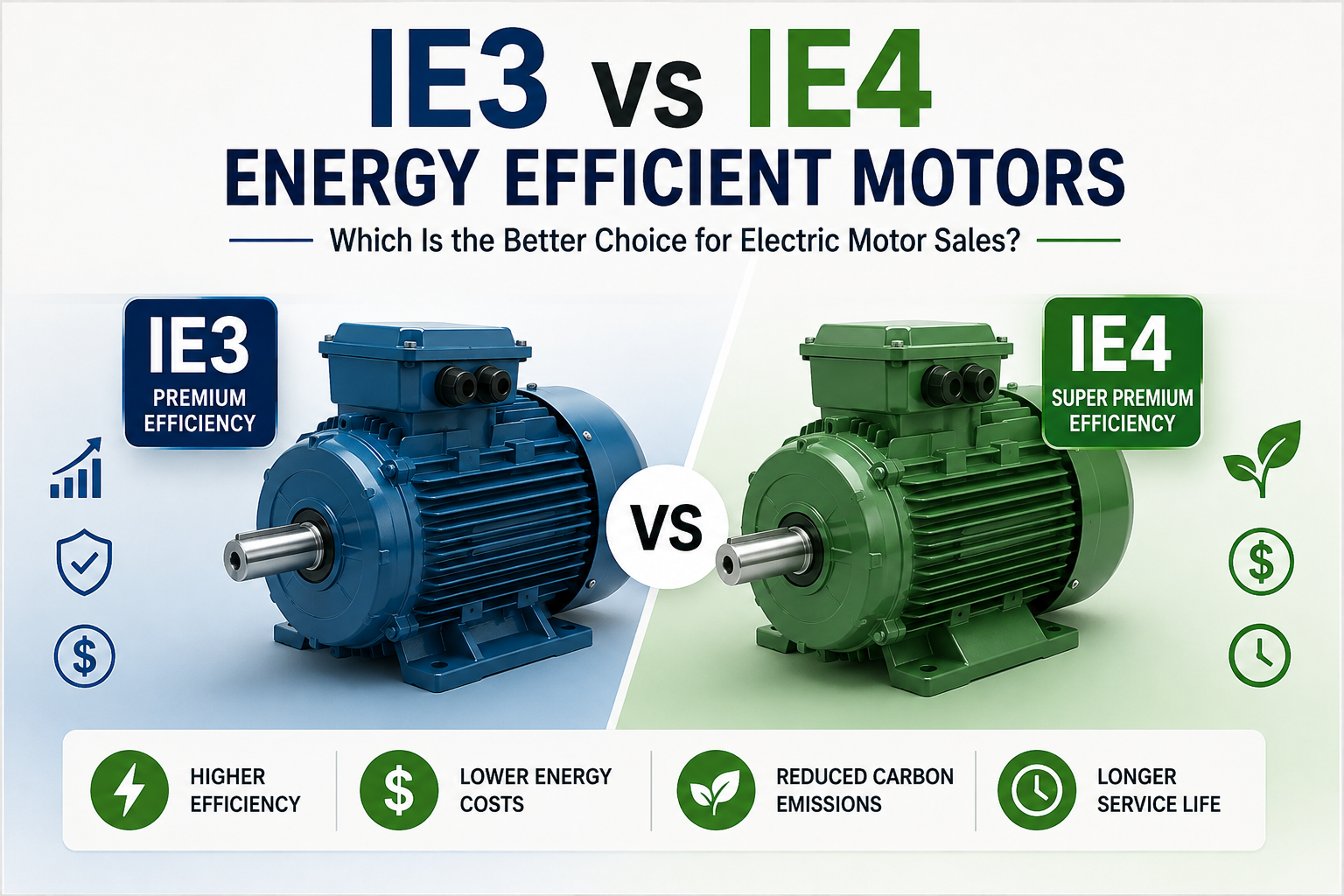
If you’ve spent any time recently talking to a supplier about industrial motors, you’ve probably had the IE3 vs IE4 conversation at least once. It comes up constantly now, and for good reason — energy costs keep climbing, and the gap between an average motor and a genuinely efficient one adds up to real money once you’re running equipment for years rather than months. IE3 vs IE4 energy efficient motors have become the two names everyone’s actually comparing these days, and understanding what separates them properly changes how you approach electric motor sales, whether you’re buying one motor or fitting out an entire plant.
Before getting into which one’s better for your situation, it helps to know where these labels actually come from, because “IE3” and “IE4” aren’t marketing terms — they’re defined efficiency classes set out under IEC 60034-30-1, the international standard the electrical industry uses to classify motor efficiency consistently across manufacturers and countries. Without that standard, every supplier could claim “high efficiency” and mean something completely different by it.
These IE ratings — International Efficiency classes — are measured through standardised testing that looks at how much input energy actually converts to useful mechanical output versus how much is lost as heat. The higher the number, the less energy is wasted for the same amount of work done. This matters in industrial settings specifically because motors often run for years at a time, sometimes continuously, and even a small efficiency gain compounds into a genuinely large saving over that kind of runtime.
Worth knowing there’s an IE5 tier too, sitting above IE4 as an emerging “ultra-premium” class, though it’s not yet the mainstream commercial standard IE3 and IE4 currently are. The efficiency ladder keeps climbing, and it’s worth keeping half an eye on where the industry’s heading even while making a decision today.
This is where a lot of confusion creeps in, so it’s worth clearing up properly. In Australia, motor efficiency is regulated under the Greenhouse and Energy Minimum Standards Act 2012 — GEMS for short — which sets Minimum Energy Performance Standards, or MEPS, for a wide range of equipment sold here, motors included. Since 2019, motors sold in Australia above a certain power threshold have needed to meet efficiency levels aligned with the IE2 class as an absolute floor — anything below that simply can’t legally be sold anymore. Since that update, IE3 has become the recognised “high efficiency” benchmark under the current MEPS framework, effectively the standard most reputable suppliers stock as their baseline offering, with IE4 sitting above it as the voluntary, premium tier for businesses wanting to go further.
So if you’re weighing up IE3 vs IE4 energy efficient motors, you’re not choosing between “legal” and “illegal” — you’re choosing between the current high-efficiency benchmark and the next step up. That distinction matters, because it means IE4 isn’t a regulatory requirement anywhere in Australia at the moment. It’s a genuine choice, made on the numbers, not on compliance.
Getting into the actual comparison now. IE3 motors are commonly referred to as premium efficiency, while IE4 sits a tier above as super-premium efficiency. In practical terms, that translates to IE4 motors losing noticeably less energy as heat than IE3 motors doing the same job, which is really the whole story behind every other benefit that follows.
A big part of how IE4 achieves that extra step up in efficiency comes down to the underlying motor technology rather than just incremental tweaks to a standard induction design. Plenty of IE3 motors are conventional induction motors, refined for efficiency through better stator and rotor design. IE4 motors, though, often achieve their efficiency gains through different underlying technology altogether — permanent magnet designs or synchronous reluctance motors, for instance — which changes some of the practical considerations around installation, not just the numbers on a spec sheet.
Power consumption differences between the two classes might look modest on paper — often a few percentage points — but a few percentage points on a motor running continuously for years at meaningful load adds up to a genuinely large cumulative saving. Heat generation and energy loss follow the same logic: lower losses mean less waste heat, which can also mean less strain on a motor over its working life.
Performance under continuous operation tends to favour the higher-efficiency class too, since less internal heat generally means less thermal stress over time. And that flows into expected service life — a motor running cooler, all else equal, often holds up longer before needing servicing or replacement.
One more practical point worth flagging: variable frequency drive compatibility. A lot of IE4 motors, particularly those using permanent magnet or synchronous reluctance technology, are commonly paired with a matched VFD to actually achieve their rated efficiency. If you’re retrofitting into an existing drive system, it’s worth confirming compatibility directly rather than assuming any VFD on hand will do the job properly.
IE3 remains a genuinely solid choice for a lot of businesses, and it’s worth being clear about why rather than treating it as simply “the cheaper option.”
Lower initial purchase cost is the obvious one, and for businesses managing tighter capital budgets, that upfront saving matters. IE3 also delivers reliable performance across a genuinely wide range of industries, without requiring the specialised drive setups that some IE4 motor types call for. And there are plenty of suitable applications where the extra efficiency step from IE4 simply wouldn’t pay back fast enough to justify the higher price — shorter-duty applications, standby equipment, or motors that don’t run continuous long hours are all reasonable candidates for sticking with IE3.
| Factor | IE3 | IE4 |
|---|---|---|
| Efficiency | Premium Efficiency | Super-premium Efficiency |
| Purchase Cost | Lower | Higher |
| Operating Cost | Moderate | Lower |
| Maintenance Requirements | Standard | Often reduced, due to lower heat stress |
| Return on Investment | Faster upfront, lower ongoing savings | Slower upfront, stronger long-term savings |
| Typical Applications | General industrial use, shorter duty cycles | Continuous operation, high-runtime equipment |
| Lifespan | Solid, standard expectations | Often extended, due to reduced thermal wear |
| Common Motor Technology | Typically standard induction design | Often induction, permanent magnet, or synchronous reluctance |
For the right application, though, IE4 genuinely earns its premium price tag.
Maximum energy savings is the headline benefit, translating directly into reduced operating costs over the motor’s working life — and for continuously running industrial equipment, that saving compounds meaningfully year over year. Lower carbon emissions follow naturally from lower energy draw, which increasingly matters for businesses reporting against sustainability targets or working within broader ESG commitments, where equipment-level efficiency choices are starting to genuinely factor into procurement decisions rather than being an afterthought. Longer equipment life is another real benefit, tied back to that reduced heat generation discussed earlier. And the ideal applications for IE4 tend to be exactly the ones running long, continuous hours — think large HVAC systems, major conveyor lines, or critical process equipment where downtime or inefficiency carries a real cost.
Some industries depend quite a bit on this choice owing to the amount of motor operation time involved.
The manufacturing sector, operating production lines for long periods of time, is able to see the effects in terms of savings in electricity usage. The mining industry operates heavy machinery constantly in areas where electricity costs are high. Water treatment facilities run pumps and equipment around the clock, making cumulative efficiency gains genuinely significant. Food processing operations, similarly continuous, benefit the same way. Agriculture, particularly irrigation and processing equipment running long seasonal hours, sees real value here too. HVAC systems, especially in large commercial or industrial buildings, are a classic IE4 use case given how many hours they log annually. And conveyor systems, often running near-continuously in warehouses and processing plants, round out the list of genuinely strong candidates for the higher efficiency tier.
If you’re replacing an existing motor rather than starting from scratch, it’s worth knowing how to check what you’ve actually got before assuming anything. Every compliant motor carries a nameplate — usually a metal plate fixed to the motor housing — listing key details including power output, speed, voltage, and its IE efficiency class. Look for markings like “IE2,” “IE3,” or “IE4” directly on that plate, alongside the relevant standard reference.
If the nameplate’s worn, missing, or unclear — which happens more often than you’d expect on older equipment — it’s worth getting a supplier or qualified electrician to properly identify the motor before assuming it meets any particular efficiency class. Guessing here can lead to a costly mismatch further down the track.
A few practical questions tend to settle this decision more reliably than gut instinct. Consider your actual operating hours first — a motor running eight hours a week has a very different payback calculation than one running continuously around the clock. Evaluate your energy consumption honestly, ideally against real utility data rather than assumptions. Understand total cost of ownership, factoring in purchase price, expected maintenance, and projected energy costs together rather than looking at purchase price alone. Review your actual load requirements, since an oversized or undersized motor undermines efficiency gains regardless of its IE rating. Check environmental conditions too — ambient temperature, dust, moisture — since these can all affect a motor’s real-world performance and lifespan.
A simple way to actually estimate potential savings: take your motor’s operating hours per year, multiply by its power draw in kilowatts, then multiply by your local electricity rate per kilowatt-hour — do that for both an IE3 and IE4 option at their respective efficiency percentages, and the difference gives you a rough annual saving figure to weigh against the extra upfront cost. It’s not a precise engineering calculation, but it’s enough to get a sense of whether the higher-efficiency option is worth pursuing further for your specific situation.
And throughout all of this, working with a trusted electric motor sales supplier who can talk you through your specific numbers, rather than just quoting spec sheets, makes a genuine difference to getting this decision right.
Apart from the choice between IE3 and IE4 motors, there are some additional factors that must match. The motor has to have the proper size not only to fit into the available space but also to meet the size of the actual load. Voltage must be coordinated with your electric system. Motor mounting must be suitable for your installation. Speed is essential for the particular application. Motor duty cycle is the factor that determines what efficiency level is cost-effective. Compliance with Australian standards, in particular, GEMS and MEPS determination, is an important condition for any motor as only the registered motors that satisfy Australian standards may be sold here.
A common and genuinely reasonable question for anyone upgrading rather than starting fresh.
Frame size and mounting compatibility need checking first — not every IE4 motor is a straightforward physical swap for an existing IE3 unit, particularly with newer motor technologies that may have different dimensions. Drive and control panel considerations matter too, especially if you’re moving to a permanent magnet or synchronous reluctance IE4 motor that expects a specifically matched VFD rather than whatever’s currently installed. In some cases, rewinding an existing motor might genuinely make more sense than replacing it outright, particularly for older equipment where full replacement carries additional costs beyond just the motor itself — though it’s worth knowing a rewound motor typically won’t reach the same efficiency as a genuinely new IE3 or IE4 unit. Before committing to any retrofit, it’s worth checking physical compatibility, drive requirements, and getting a straight answer on whether the numbers actually justify the switch for your specific setup.
Genuinely, it depends — but here’s how to actually think it through rather than guessing.
Initial cost versus lifetime savings is the core trade-off: IE4 costs more upfront, but the ongoing energy savings can outweigh that gap over the motor’s working life, particularly for high-runtime applications. The energy payback period — how long it takes for accumulated energy savings to cover that extra upfront cost — varies a lot depending on operating hours; a motor running continuously, 24/7, might pay back the price difference within a couple of years, while one running only a handful of hours a week could take considerably longer, sometimes long enough that it never quite justifies the premium. Long-term return on investment tends to favour IE4 specifically for equipment expected to stay in service for many years at meaningful load — the numbers simply don’t work the same way for short-lived or lightly used equipment.
Worth checking too whether any government rebates or energy efficiency incentive schemes apply in your state — several jurisdictions in Australia have offered incentives tied to upgrading industrial equipment to higher efficiency classes, and where available, these can meaningfully shorten the payback period and tip the decision further in IE4’s favour.
If you’re weighing this up for your own operation, it’s worth getting an actual quote and payback estimate from a proper electric motor sales supplier based on your real operating numbers, rather than relying on general figures like these.
A handful of avoidable errors show up repeatedly. Choosing based only on price, without factoring in ongoing energy costs, often costs more over the motor’s lifetime than it saves upfront. Ignoring motor efficiency ratings entirely and just buying “whatever’s in stock” misses the whole point of this comparison. Selecting the wrong motor size — oversized or undersized for the actual load — undermines efficiency regardless of IE class. Overlooking future energy costs, especially as electricity prices continue trending upward, means underestimating the real value of the higher-efficiency option. Assuming any replacement motor will physically fit and integrate without checking compatibility first is a genuinely common and costly mistake during retrofits. And buying from an inexperienced electric motor sales supplier who can’t properly walk you through these trade-offs often means ending up with a motor that’s technically fine but not actually right for your application.
Getting proper guidance through this decision genuinely changes the outcome.
Matching the motor to the application requires understanding your actual operating conditions, not just reading a spec sheet. Technical assistance is required in case there are any concerns regarding the compatibility of drives and installation details. Availability of products – whether in terms of genuine availability or long waiting periods for specially made energy-efficient models – has an impact on your actual schedule, and you should clarify this instead of assuming that everything will be available easily.
Before committing to a supplier, it’s worth verifying they can confirm GEMS compliance and registration for whatever motor they’re proposing, along with genuine brand authorisation rather than grey-market stock — these are reasonable, standard things to ask about before a significant equipment purchase.
Both IE3 and IE4 motors have real, valid use cases — this was never a question of one being universally superior to the other. IE3 remains a dependable, cost-effective option for a huge range of applications, while IE4 earns its higher price tag specifically where continuous operation and long-term energy savings make the extra investment pay off. The right choice ultimately comes down to your operational requirements, your energy costs, and how long you expect the equipment to stay in service.
Working with an experienced electric motor sales supplier like Electro Rewinds, is genuinely the most reliable way to land on the right decision — someone who can run the actual numbers for your specific setup, rather than leaving you to guess between two solid options based on a spec sheet alone.
If you’ve spent any time recently talking to a supplier about industrial motors, you’ve probably had the IE3 vs IE4 conversation at least once. With energy costs continuing to rise, choosing between IE3 and IE4 energy efficient motors can have a significant impact on long-term operating costs, energy consumption, equipment performance, and service life. This guide compares IE3 and IE4 motors, their efficiency levels, applications, costs, maintenance considerations, Australian GEMS and MEPS requirements, and the factors businesses should consider before choosing the right motor for their operation.